Proprietorship Company Registration
Understanding Sole Proprietorship: A Comprehensive Guide
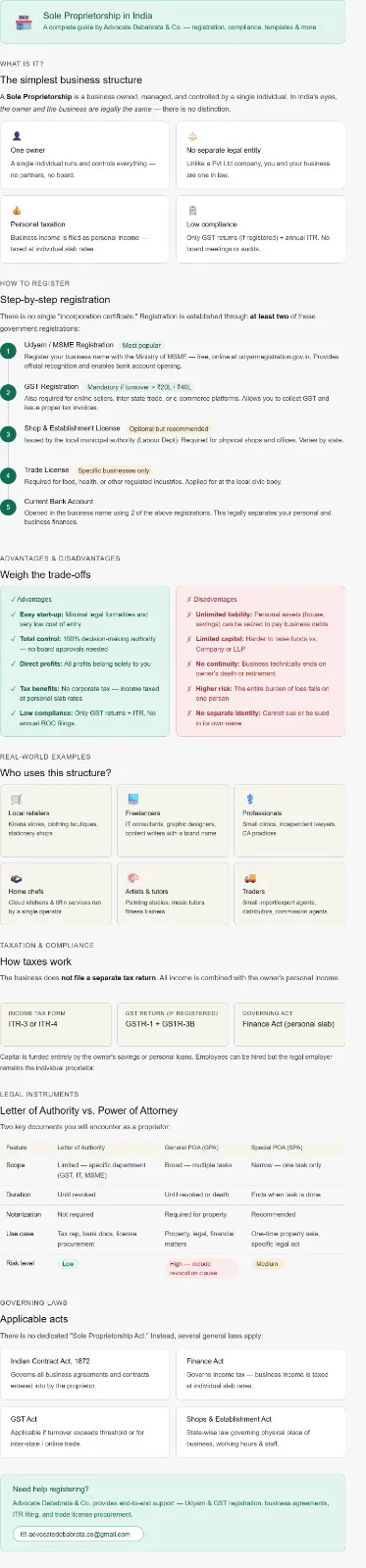
A Sole Proprietorship is the simplest and most common form of business structure in India. It is a business owned, managed, and controlled by a single individual. In the eyes of the law, there is no legal distinction between the owner and the business entity.
1. Definition & Meaning
- Meaning: The word “Sole” means single and “Proprietor” means owner. It refers to a person who carries on a business exclusively on their own account.
- Legal Status: Unlike a Private Limited Company, a proprietorship is not a separate legal entity. The owner and the business are one and the same.
2. Applicable Acts & Laws
In India, there is no specific “Sole Proprietorship Act.” Instead, it is governed by various general laws:
- Indian Contract Act, 1872: Governs the business agreements and contracts.
- Finance Act: Governs the Income Tax (taxed at individual slab rates).
- GST Act: If turnover exceeds the threshold or for inter-state trade.
- Shops and Establishment Act: Governed by respective State laws.
3. How to Register a Proprietorship?
There is no formal “incorporation certificate” for a proprietorship. Registration is established through government tax registrations. To start, you typically need at least two of the following:
- MSME/Udyam Registration: The most popular way to register a business name with the Ministry of Micro, Small, and Medium Enterprises.
- GST Registration: Mandatory if your annual turnover exceeds ₹20/40 Lakhs or if you sell products online/inter-state.
- Shop & Establishment License: Obtained from the local municipal authority (Labour Department).
- Trade License: Specific to certain types of businesses (e.g., food, health).
- Current Bank Account: Opened in the business name using the above registrations.
4. Advantages & Disadvantages
| Advantages | Disadvantages |
|---|---|
| Easy Start-up: Minimal legal formalities and low cost of entry. | Unlimited Liability: The owner is personally responsible for all business debts; personal assets can be seized. |
| Total Control: You make 100% of the decisions without needing board approval. | Limited Capital: Harder to raise funds compared to a Company or LLP. |
| Direct Profits: All profits belong solely to the owner. | Lack of Continuity: The business technically ends if the owner passes away or retires. |
| Tax Benefits: No corporate tax; business income is taxed as personal income. | Higher Risk: The entire burden of loss falls on one person. |
2. A5. How It Works? & Laws
- Management: : The owner brings the capital, manages the daily operations, and hires employees if needed.
- Capital: Funded entirely by the owner’s savings or personal loans.
- Taxation: The business does not file a separate tax return. The owner files ITR-3 or ITR-4 combining business income with personal income..
- Compliance: : Generally lower compliance than Companies—only GST returns (if registered) and Income Tax returns are required.
6. Examples &
- Local Retailers: : Kirana stores, clothing boutiques, or stationery shops.
- Freelancers: Graphic designers, IT consultants, or content writers working under a brand name.
- Professional Services: Small clinics (Doctors), independent Legal practitioners, or CA firms.